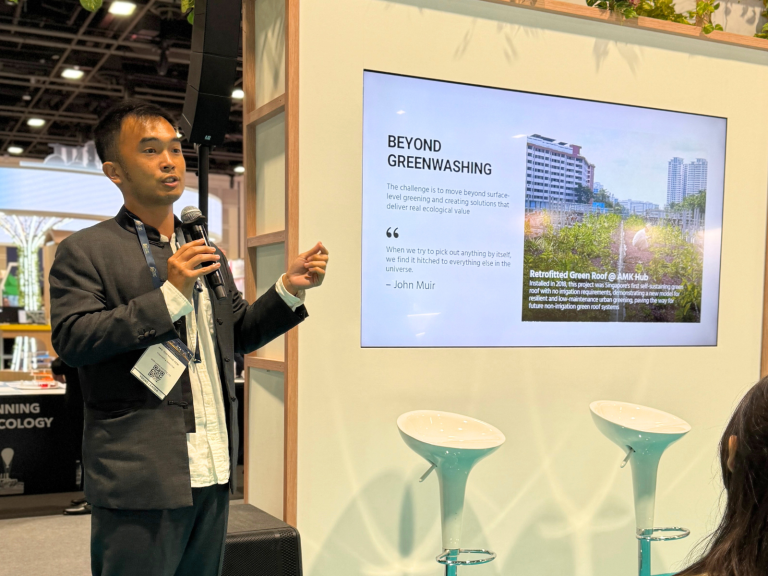
As Singapore continues to advance its skyrise greenery ambitions, a major constraint remains the city’s extensive stock of ageing buildings that were not designed to support conventional green roof systems. Structural load limitations, access challenges, and long-term maintenance requirements have historically restricted the adoption of rooftop greenery on legacy infrastructure. The Ang Mo Kio MRT Station project was conceived as a demonstration to address these barriers. Installed on a 35-year-old reinforced concrete roof, the project illustrates how lightweight, non-irrigated green roof technologies can enable environmental enhancement within existing structural constraints.
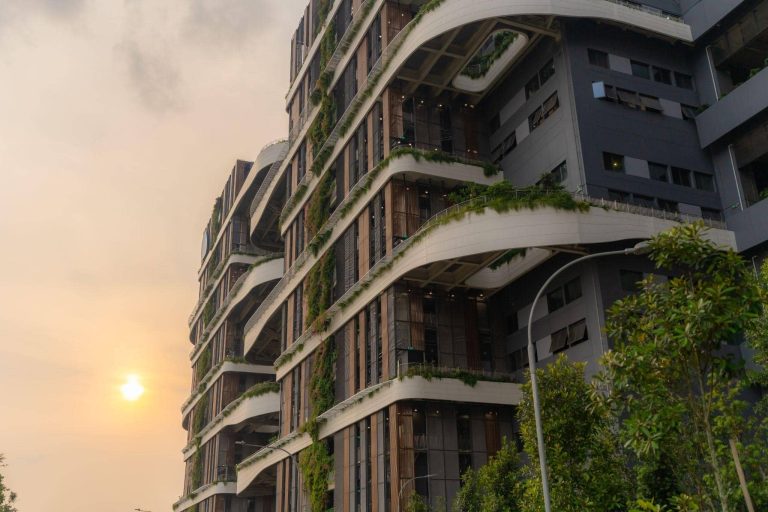
Growing climate challenges demand smarter, greener solutions. Green infrastructure, such as green roofs, green walls, and urban greening, is becoming a key part of how cities can adapt and thrive in the face of extreme weather.
Scope of Work: Designing and Installing a Non-Irrigated Green Roof on Ang Mo Kio MRT
GWS Living Art was appointed to design and install a non-irrigated green roof system on the roof of Ang Mo Kio MRT Station. The scope encompassed a detailed assessment of the roof’s structural capacity, design development for a lightweight green roof assembly, and execution of works under strict safety, access, and operational constraints. A total of 700 m² of roof area was retrofitted using GWS Living Art’s proprietary GaiaMat™ system, with works coordinated to align with MRT operational requirements and safety regulations.
Objectives: Enabling Skyrise Greening Within Structural and Maintenance Constraints
The primary objective of the project was to validate the technical feasibility of retrofitting green roof systems onto Singapore’s ageing building stock. This included demonstrating that skyrise greening is achievable on structures with limited load capacity, eliminating the need for irrigation to reduce maintenance demands, and proving that long-term environmental performance can be achieved without compromising structural integrity. The project also sought to establish a scalable reference model that could inform future retrofitting initiatives across similar legacy infrastructure.
Project Highlights: Lightweight Green Roofs, Drought-Tolerant Planting, and Modular Design

Layers of GaiaMat™: Pre-Vegetated Mat, Hygroscopic Absorption Layer, Water Retention Layer
The defining feature of the project was the deployment of the GaiaMat™ system, which is engineered to be three to four times lighter than conventional soil-based green roof assemblies. Its high water retention capacity enables vegetation to survive extended dry periods and recover during rain events, removing the need for permanent irrigation systems and their associated loading. The roof layout was designed with two parallel planting zones separated by a central access corridor, ensuring safe movement for maintenance personnel while maintaining compliance with workplace safety requirements.


Drought-Tolerant Plants: Kalanchoe Daigremontiana, Ageratum Conyzoides
A drought-tolerant planting palette was carefully selected by GWS Living Art’s horticulture team to suit the non-irrigated conditions. Species were chosen for their resilience, low maintenance requirements, and ability to self-propagate, allowing the vegetated surface to maintain coverage over time. The modular nature of the pre-grown vegetated mats further enhanced installation efficiency, enabling rapid placement and adaptation to site-specific constraints.
Challenges: Overcoming Load Restrictions, Logistics, and Operational Windows


In addition, all installation works were restricted to overnight hours between 1:00 am and 4:30 am to avoid disruption to MRT operations. This narrow work window required careful planning, phased zoning of the installation area, and streamlined construction processes to ensure productivity and safety within the limited timeframe.
Advancing Skyrise Greening Through Lightweight, Low-Maintenance Systems
The successful completion of the Ang Mo Kio MRT Station green roof demonstrates that retrofitting greenery onto older structures is both technically achievable and operationally viable when appropriate lightweight technologies are employed. Seven years after installation, the GaiaMat™ system continues to perform reliably, with healthy vegetation coverage, intact system layers, and minimal maintenance requirements.
Beyond its technical success, the project illustrates how strategic plant selection and modular green roof systems can contribute to urban biodiversity by providing supplementary habitats for birds and insects. This project provides a scalable reference for expanding skyrise greening across Singapore’s existing building inventory using GaiaMat™, supporting climate resilience, urban heat mitigation, and long-term environmental quality.
If you’d like to learn more about our approach to green engineering and nature-integrated design solutions, get in touch with us at hello@gwslivingart.com