At this year’s World Cities Summit (WCS) 2026, GWS Living Art was proud to be part of the conversation shaping the future of sustainable cities.
Throughout the summit, our team welcomed visitors to our exhibition booth, showcasing the technologies behind our green wall and green roof systems. Conversations with architects, developers, government agencies, and fellow industry practitioners all centred around one key question: How can urban greenery deliver lasting ecological value, not just visual impact?
Moving Beyond Greenwashing
The theme of “Moving Beyond Greenwashing” formed the heart of our Founder Zac Toh’s presentation at the CLC World Stage as part of the World Cities Summit Young Leaders Fan-the-Flame Platform.
“At GWS Living Art, the focus has always been on building systems that are sustainable in the truest sense: Low in waste, designed with a cradle-to-cradle mindset, and built to last with minimal upkeep.”
Urban greening has become an increasingly common feature of cities around the world. But as Zac shared during his presentation, simply adding plants to buildings is no longer enough. The real challenge lies in creating green infrastructure that is designed to thrive over the long term, with minimal maintenance, reduced resource consumption, and measurable environmental benefits.
This philosophy has guided our work from the very beginning. Rather than designing for launch-day aesthetics alone, we focus on systems that are lightweight, durable, resource-efficient, and built using cradle-to-cradle principles wherever possible.
Engineering Green Infrastructure That Lasts

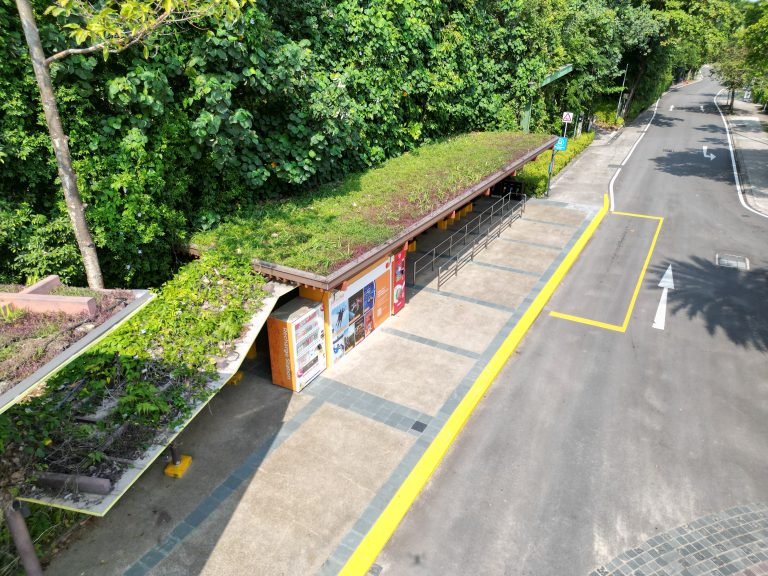
One project highlighted during the presentation was our green roof at Ang Mo Kio MRT Station, first installed in 2018.
Instead of relying on conventional soil-based systems, the project uses GWS Living Art’s proprietary soilless GaiaMat system, combined with carefully selected plant species capable of surviving on rainfall alone.
Eight years later, the project continues to demonstrate what resilient design can achieve.
What began as a pilot has since expanded across Singapore, with the same system now installed on more than 500 bus stops, demonstrating that resilient, low-maintenance greenery can be both practical and beautiful.
Learn more about our Ang Mo Kio MRT Station green roof here!
Designing Ecosystems, Not Just Landscapes

Another project Zac shared was the iconic waterfall landscape at Mandai Bird Paradise.
While many visitors assume the vegetation developed naturally over time, every layer of the landscape was intentionally designed. The artificial rock formation was paired with a custom micro-misting system to recreate the humidity of a Javan waterfall, while native plant species were carefully selected to provide food sources for local birdlife. The result is more than an immersive landscape, it is an ecosystem designed to support biodiversity while creating memorable visitor experiences.
This project reflects an important principle behind our work: successful urban greening is about understanding ecological relationships, not simply installing plants.
Learn more about our Mandai Bird Paradise project here!
From Green Infrastructure to Green Communities

After years of delivering nature-based infrastructure, Zac reflected on another question that has shaped the next chapter of his journey:
“How do we bring that same spirit of greenery to the people living in these cities?”
This question led to the founding of City Sprouts in 2019, creating spaces where communities can reconnect with nature through urban farming, education, and shared experiences.
Today, City Sprouts engages tens of thousands of participants annually through programmes, events, and partnerships that demonstrate how nature can strengthen not only our cities, but also the communities within them.
A Living Lab for Urban Innovation

As cities become more complex, creating resilient urban environments requires more than proven solutions, it requires continuous experimentation.
“We want to build something closer to an evergreen living lab — a space where other companies, startups, and independent practitioners can come and experiment directly, not just with us, but alongside us.”
Rather than tackling challenges such as reducing maintenance demands or improving long-term environmental monitoring in isolation, we believe innovation happens best through collaboration, creating an ecosystem where ideas can be tested, shared, and accelerated.
This vision is already taking shape at VidaCity @ One-North. Home to one of GWS Living Art’s most ambitious vertical greenery projects, the green wall features over 200 species of plants, creating a rich and diverse ecosystem within an urban setting. More than a showcase installation, it serves as a living testbed where we can observe how different plant species perform over time, evaluate new technologies, and gather long-term data under real-world conditions.
More importantly, the site is designed for collaboration. By opening the space to partners across industry, academia, and the startup ecosystem, we hope to encourage experimentation in areas such as ecological monitoring, biodiversity enhancement, maintenance optimisation, and emerging urban technologies.
This approach reflects a core belief shared by both GWS Living Art and City Sprouts: the challenges facing our cities are too interconnected for any single organisation to solve alone. By bringing together expertise across agri-food, urban solutions, and energy, we can collectively develop innovations that make our cities not only greener, but more resilient for generations to come.
Conversations That Matter

Beyond the presentation, our booth became a space for meaningful conversations throughout the summit.
Visitors explored physical samples of our green wall and green roof systems, learnt about our lightweight green roof technology, and exchanged ideas on biodiversity, maintenance, heat mitigation, and long-term performance.
These exchanges reaffirmed something we’ve always believed: The future of urban greening isn’t about adding more greenery for appearance’s sake. It’s about designing systems that genuinely work, for people, biodiversity, and the cities we call home.
Looking Ahead
World Cities Summit 2026 reminded us that resilient cities are built through collaboration.
We’re grateful to everyone who visited our booth, attended Zac’s presentation, and shared ideas with us throughout the event.
As cities continue to evolve, GWS Living Art remains committed to creating nature-based solutions that move beyond greenwashing, combining ecological science, thoughtful engineering, and long-term sustainability to build greener cities from the ground up.
We look forward to continuing the conversation.